How Institutions Replace Moral Judgment with Process and Performance
And days later the leader of a G7 nation responded:
“We need to work through our differences… to listen to each other… to go beyond the frustrations people are feeling…” Canadian Prime Minister Justin Trudeau,
The words are correct.
The tone is soothing.
The moral instinct is absent.
That clip unsettled me not because it denied the horror, but because it translated horror into atmosphere. Judgment dissolved into mood. Violence became a problem of emotional temperature.
“This is the Patel Method in practice: acknowledge the harm, then translate it into mood, tension, and the language of listening.”
In operational systems, the rule is simple: Process is King.
I saved that clip because I sensed I was watching a leadership style, not a statement. Years later I understood what it represented: A system that converts tragedy into language and calls it clarity.
This book begins there.
Institutions are evaluated not by outcomes, but by tone.
Leaders are rewarded not for decisions, but for fluency in the vocabulary of virtue.
Something fundamental has shifted in how legitimacy is produced.
Where previous generations argued over ideas, contemporary institutions manage atmosphere.
Where truth once mattered, process substitutes.
Where leadership once meant judgment, it now means reassurance.
“In modern public life, virtue is not a stable attribute; it is a behaviour that must be renewed in every speech, every partnership, and every public moment.”
Virtue is no longer simply practiced.
It is performed.
And performance scales.
In modern institutions, virtue is no longer primarily a moral quality.
It is a professional asset.
Universities, corporations, foundations, and governments now operate within an environment where:
In such an environment, a new demand emerges: leaders who can stabilize tension without resolving it.
This book examines how that demand reshapes leadership itself.
Eboo Patel is not examined here because he is uniquely powerful.
He is examined because he is structurally revealing.
Through Interfaith America, Patel built a model of leadership that is:
His significance lies not in doctrine, but in design.
Institutions do not purchase solutions.
They purchase insulation.
“What circulates in this market are not ethical truths, reforms, or resolutions, but reassurance, legitimacy, and emotional safety.”
Like carbon credits offset environmental risk, virtue credits offset moral risk. They allow institutions to demonstrate concern without incurring confrontation.
Patel did not create this system.
He perfected its architecture.
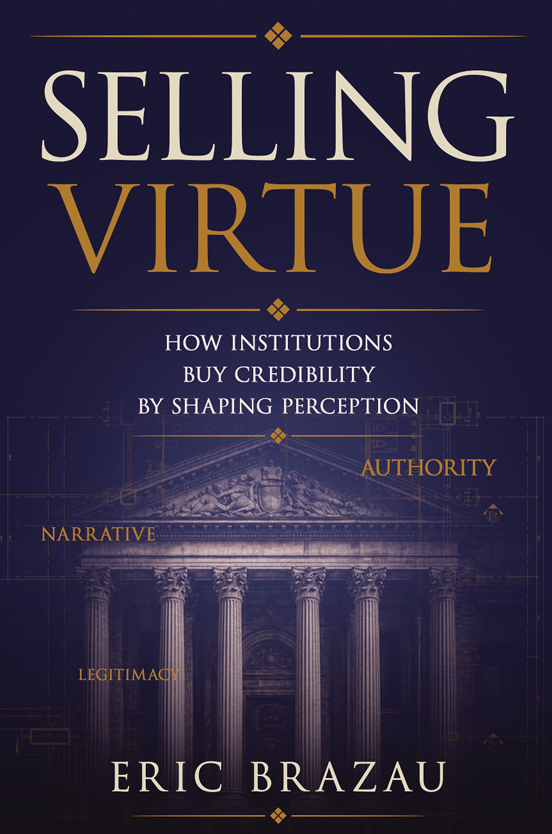
This book introduces the concept of a virtue economy.
In this economy:
Signals outperform outcomes
Atmosphere outranks judgment
Reassurance replaces resolution
They elevate leaders who soothe rather than clarify.
They invest in frameworks that stabilise legitimacy rather than solve contradictions.
Virtue becomes insulation — and insulation has limits.
A system engineered to avoid moral collision functions smoothly only while conflict remains theoretical.
Once reality refuses translation — once violence, doctrine, or power demand judgment — the limits of atmosphere management surface immediately.
This book asks a simple question:
What happens when institutions trained to manage tension must confront truth?
This volume moves one layer deeper.
It examines the Patel Method — a framework for institutional influence that embeds moral language into civic structures, turning advocacy positions into administrative norms rather than political arguments.
If the earlier books mapped actors and arguments, this book maps the marketplace that selects them.
If you want to understand how legitimacy is manufactured, the inquiry begins here.
Leaders are rewarded for tone, not decisions.
Virtue is performed, not practiced.
In this environment, figures like Eboo Patel do not disrupt the system.
They reveal it.
The Economy of Being Virtuous maps the marketplace where reassurance outperforms truth and perception outranks outcomes. Institutions purchase insulation instead of solutions.
This is not a book about interfaith dialogue.
It is a book about how legitimacy is manufactured.